We're hiring ! Join us and make a difference in our hospitals


Liver Biopsy
To ensure you are clearly informed about this procedure, we invite you to read this information carefully. Your doctor is available to provide any additional details you may need.
What is a liver biopsy?
A liver biopsy is a procedure in which a small sample of liver tissue is taken to make a precise diagnosis of liver disease. This allows your doctor to treat the problem optimally. The tissue is analyzed under a microscope, and the final result is usually available within a week.
Why perform a liver biopsy?
Your doctor has suggested this procedure due to symptoms and blood test abnormalities indicating a possible liver problem. Obtaining a liver tissue sample allows laboratory analysis under a microscope to determine the cause and severity of the problem. Measuring liver pressures (porto-systemic gradient) helps assess the severity of the disease and its impact on the veins supplying the liver (portal hypertension), guiding treatment.
How to prepare for a liver biopsy?
Before the procedure:
Inform your doctor about your medical history and any medications you usually take (especially blood-thinning medications: aspirin, Plavix, Sintrom, …). If you have known allergies, inform your doctor, and for women, indicate if you are pregnant.
You must fast (no food or drink) for 6 hours before the procedure.
How is a liver biopsy performed?
The biopsy can be performed using two approaches, depending on the suspected problem and/or current treatment.
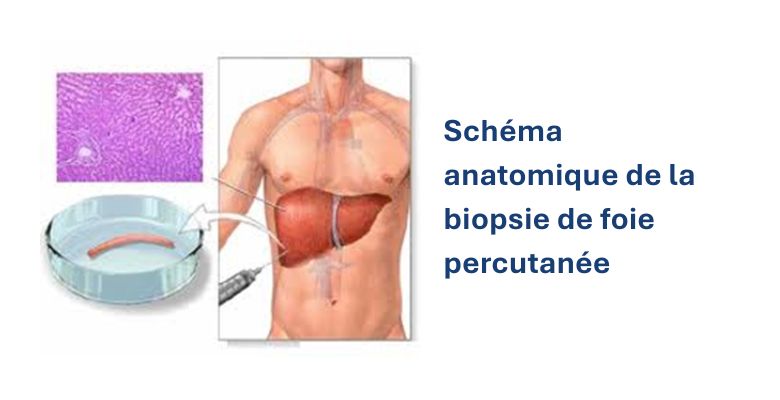
Percutaneous liver biopsy (through the skin of the right flank)
After radiographic or ultrasound localization, local anesthesia is applied to the skin and abdominal wall (between the ribs on the right side). You will be asked to hold your breath. A liver puncture is then performed quickly using a needle, a pressure dressing is applied, and you must lie on your right side for 4 hours. This procedure can be performed under sedation (injection of a sedative if needed) and is organized as a 24-hour hospital stay for monitoring and bed rest.

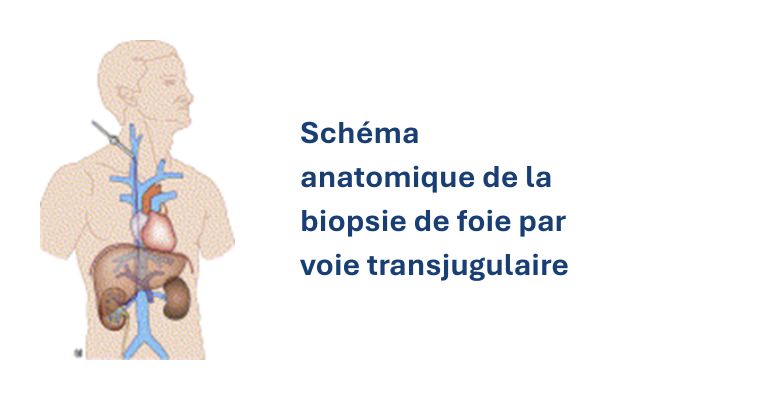
Transjugular liver biopsy (via a neck vein) and suprahepatic catheterization
After local anesthesia of the neck skin, an introducer is placed in a neck vein. A catheter is guided through the blood vessels to the liver under radiographic control. Liver pressures are measured, and a puncture is performed to obtain a tissue sample. A pressure dressing is then applied to the neck for 24 hours.
This procedure can be performed under sedation (injection of a sedative if needed) and is organized as a 24-hour hospital stay for monitoring and bed rest.

Possible complications of a liver biopsy
Any medical procedure, even performed with proper expertise and according to current scientific and regulatory standards, carries a risk of complications.
Complications of liver biopsy are rare (hematoma, bleeding) and may be influenced by your medical history or ongoing treatment.
If you experience abnormal symptoms (abdominal pain, dizziness, fever, jaundice), contact the physician who performed the procedure during office hours, Monday to Friday, 8:00–16:30, at +32 (0)2 555.32.92, Endoscopy Clinic or at +32 (0)2 555.59.95 (medical contact).
If you cannot reach them, promptly contact your general practitioner or go to the hospital Emergency Department.